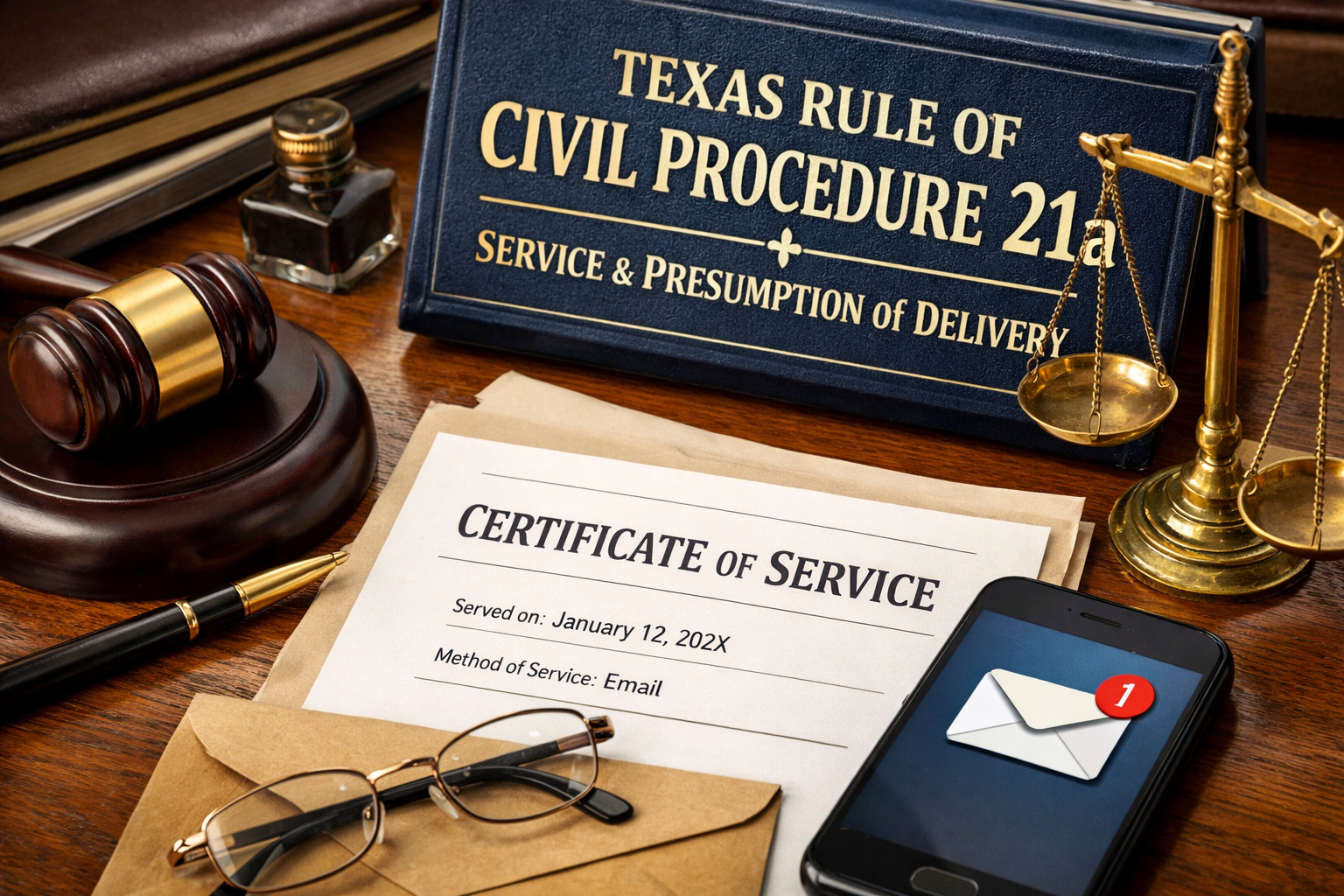
Texas Rule 21a: How Service of Court Documents Works in Texas
Once a lawsuit has been filed in Texas, the parties usually must continue serving each other with pleadings, motions, notices, and other court documents throughout the case. But how are those documents legally served? And what happens if someone claims that a document was never received?
Texas Rule of Civil Procedure 21a governs the methods used to serve many court documents after a lawsuit has begun. The rule addresses electronic service, email, mail, personal delivery, commercial delivery, and other authorized methods of service.
Rule 21a also creates an important evidentiary rule: a proper certificate of service can constitute prima facie evidence that service occurred.
For Texas litigants, that can become important when a deadline, hearing, motion, or judgment depends on whether a party received proper notice.
What Is Texas Rule of Civil Procedure 21a?
Texas Rule of Civil Procedure 21a is titled “Methods of Service.”
Rule 21 generally requires pleadings, motions, and certain other documents to be served on the parties to a case. Rule 21a then establishes how that service may be accomplished.
Importantly, Rule 21a generally concerns documents served after a lawsuit is underway. It is not the ordinary rule governing service of the initial citation that formally brings a defendant into a lawsuit.
That distinction matters. Serving a defendant with citation at the beginning of a lawsuit involves different rules and requirements from serving motions, notices, pleadings, and other documents later in the case.
How Are Electronically Filed Documents Served in Texas?
Electronic filing and electronic service have become central features of Texas civil litigation.
Under Rule 21a(a)(1), when a document is electronically filed under Rule 21, it generally must be served electronically through the electronic filing manager if the email address of the party or attorney being served is on file with the electronic filing manager.
For attorneys practicing in Texas courts, this means that filing a document through the electronic filing system will frequently be accompanied by electronic service on the other attorneys or parties registered to receive service.
This system creates an electronic record that can become important if the parties later dispute whether service occurred.
If the recipient's email address is not on file with the electronic filing manager, Rule 21a permits service as provided for documents that are not electronically filed.
How Can Documents That Are Not Electronically Filed Be Served?
Rule 21a provides several permissible methods for serving a document that is not electronically filed.
Depending on the circumstances, service may be accomplished:
- in person;
- by mail;
- by commercial delivery service;
- by fax;
- by email; or
- by another method directed by the court in its discretion.
The proper method therefore depends partly on whether the document was electronically filed and whether the recipient is registered for electronic service.
Can Court Documents Be Served by Email in Texas?
Yes, in circumstances authorized by Rule 21a.
For documents that are not electronically filed, Rule 21a expressly permits service by email. But attorneys and litigants should not confuse ordinary email with the electronic-service requirements applicable to electronically filed documents.
When an electronically filed document must be served through the electronic filing manager under Rule 21a(a)(1), simply sending a separate ordinary email should not be treated as a substitute for complying with the rule's electronic-service requirement.
Can Court Documents Be Served by Mail in Texas?
Rule 21a also permits service by mail for documents that may be served under Rule 21a(a)(2).
The timing of service can matter. Rule 21a contains provisions establishing when different methods of service are considered complete.
That can become particularly important when service triggers a response deadline or when a party argues that a document was not received in time to take required action.
What Is a Certificate of Service?
A certificate of service is a statement associated with a court filing indicating that the filing was served as required.
Certificates of service are important because Rule 21a(e) gives them an evidentiary effect.
The rule provides that a certificate by a party or attorney of record showing service is prima facie evidence of the fact of service.
In practical terms, a proper certificate of service can establish an initial showing that service occurred without requiring the serving party to begin by separately proving delivery through testimony.
Does a Certificate of Service Prove That a Document Was Received?
A certificate of service is powerful, but it does not necessarily end the inquiry.
Texas courts recognize that proper service under Rule 21a can create a rebuttable presumption of receipt. A party may offer evidence showing that the document was not actually received.
The Supreme Court of Texas has explained that when notice is properly sent under Rule 21a, a presumption of receipt arises. But that presumption may disappear when competent evidence of nonreceipt is introduced.
This distinction can become critical when a party says:
“I never received the motion.”
The existence of a certificate of service may initially favor the party claiming that service occurred. But Rule 21a expressly allows evidence that the document was not received.
How Can Someone Rebut the Rule 21a Presumption of Service?
A party disputing service should ordinarily do more than simply point to uncertainty in the record.
Evidence relevant to nonreceipt can depend on the method of service and the particular facts of the case. It may include, for example:
- an affidavit or testimony stating that the document was not received;
- evidence that service was sent to an incorrect address;
- electronic records showing a delivery problem;
- returned or undelivered mail;
- records concerning the electronic filing or service system; or
- other evidence contradicting the claimed service.
Whether the evidence is sufficient is ultimately a question for the court.
Texas appellate courts have repeatedly addressed disputes in which a certificate of service created prima facie evidence of service but the opposing party attempted to establish nonreceipt.
What Happens If a Court Document Was Never Received?
Nonreceipt can have serious consequences because many litigation events are time-sensitive.
A party who does not receive a motion or notice might miss:
- a response deadline;
- a hearing;
- a submission date;
- a discovery deadline;
- a trial setting; or
- another opportunity to protect the party's rights.
Rule 21a therefore expressly contemplates proof that a document was not received. When the court finds that a document was not received—or, in certain circumstances involving mail, was not timely received—the rule permits the court to extend the time for required action or grant other relief it considers just.
The appropriate remedy will depend on what happened in the particular case.
Is Rule 21a the Same as Service of Citation?
No.
This is one of the most important distinctions for nonlawyers encountering Rule 21a.
Service of citation is the formal process generally used to notify a defendant that a lawsuit has been filed against that defendant. Rules governing citation impose their own requirements concerning who may serve citation, how service may be accomplished, and how service is documented.
Rule 21a service, by contrast, generally concerns service of pleadings, motions, notices, and other documents after the lawsuit is already underway.
A person should therefore not assume that compliance with Rule 21a is sufficient to accomplish initial service of process on a defendant.
Why Does Texas Rule 21a Matter?
Rule 21a sounds procedural, but service disputes can affect substantive outcomes.
Consider a party who claims not to have received a motion scheduled for submission. If the record contains a certificate showing proper service, the court may begin with prima facie evidence that service occurred. The party claiming nonreceipt may then need to present evidence rebutting that showing.
Conversely, evidence demonstrating that the document was not received can become important in seeking additional time or other appropriate relief.
A seemingly mundane question—“Was this document properly served?”—can therefore determine whether a party had adequate notice and an opportunity to respond.
Practical Tips for Texas Litigants
Parties and attorneys should maintain good records of service throughout a lawsuit.
For electronically served documents, retaining electronic filing and service confirmations can help establish what was transmitted and when. For other methods, mailing records, delivery confirmations, emails, and similar documentation may become useful if service is later disputed.
Likewise, a party who believes that a document was never received should preserve evidence supporting that contention rather than relying solely on memory or an unsupported assertion.
Frequently Asked Questions About Texas Rule 21a
What is Rule 21a in Texas?
Texas Rule of Civil Procedure 21a establishes methods for serving many pleadings, motions, notices, and other documents during Texas civil litigation.
Does Texas Rule 21a allow electronic service?
Yes. Electronically filed documents generally must be served through the electronic filing manager when the recipient's email address is on file with that system.
Can you serve court documents by email in Texas?
Rule 21a permits email as a method of service for documents covered by Rule 21a(a)(2). Electronically filed documents, however, are subject to the electronic-service requirements in Rule 21a(a)(1).
What is a certificate of service in Texas?
A certificate of service is a certification showing that a document was served. Under Rule 21a(e), a certificate by a party or attorney of record showing service constitutes prima facie evidence of the fact of service.
What if I never received a document that the other side says was served?
Rule 21a permits a party to offer proof that a document was not received. Evidence of nonreceipt can rebut the presumption arising from proper service and may support additional time or other relief from the court.
Does Rule 21a govern service of the original lawsuit?
Generally, no. Initial service of citation is governed by separate rules. Rule 21a primarily addresses service of documents during an existing lawsuit.
Conclusion
Texas Rule of Civil Procedure 21a plays an important role in determining how court documents are served during a Texas lawsuit and how courts resolve disputes over whether service occurred.
Electronically filed documents are generally served through the electronic filing manager when the recipient's email address is registered with that system. Other documents may be served through methods including personal delivery, mail, commercial delivery, fax, or email, as permitted by the rule.
Just as importantly, a certificate of service can constitute prima facie evidence that service occurred and create a rebuttable presumption of receipt. A party claiming nonreceipt may present evidence challenging that presumption.
For Texas litigants, keeping accurate service records—and acting promptly when service is disputed—can prevent a seemingly small procedural issue from becoming a significant problem in the case.
This article provides general information about Texas civil procedure and is not a substitute for legal advice concerning a particular lawsuit.
At David C. Barsalou, Attorney at Law, PLLC, we help clients navigate business, family, tax, estate planning, and real estate matters ranging from document drafting to litigation with clarity and confidence. If you’d like guidance on your situation, schedule a consultation today. Call us at (713) 397-4678, email barsalou.law@gmail.com, or reach us through our Contact Page. We’re here to help you take the next step.