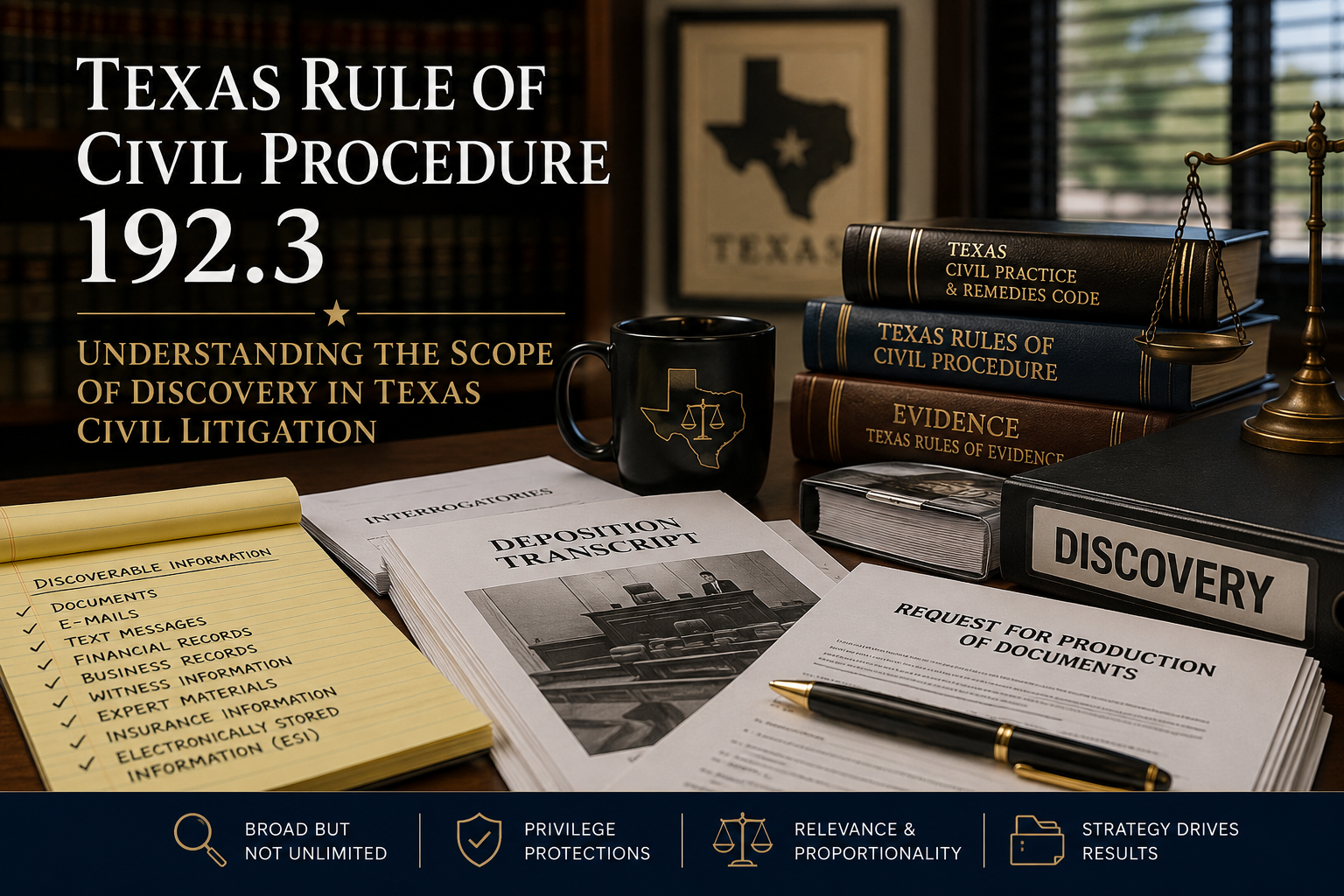
Discovery is often where Texas lawsuits are won or lost. Many litigants mistakenly believe that if information might help their case, they are automatically entitled to obtain it. Texas law is broader than many people expect—but it is not unlimited. The boundaries are established primarily by Texas Rule of Civil Procedure 192.3, which defines the scope of permissible discovery.
Understanding this rule is essential for businesses, property owners, families involved in litigation, landlords, contractors, and anyone pursuing or defending a civil lawsuit.
What Does Rule 192.3 Say?
Texas Rule of Civil Procedure 192.3 provides in part:
"A party may obtain discovery regarding any matter that is not privileged and is relevant to the subject matter of the pending action..."
The Rule further provides that it is not grounds for objection that the information sought would be inadmissible at trial if the information "appears reasonably calculated to lead to the discovery of admissible evidence."
Although Texas courts now place greater emphasis upon relevance and proportionality than decades ago, Rule 192.3 remains the foundation defining what parties may seek during discovery.
Why Is Discovery So Broad?
The purpose of discovery is to eliminate surprise at trial.
Rather than allowing parties to ambush one another with previously unknown evidence, Texas law generally requires both sides to exchange information before trial so disputes can be decided on their merits.
This means parties may often discover:
- Documents
- Emails
- Text messages
- Financial records
- Business records
- Medical records (when relevant)
- Photographs
- Videos
- Witness identities
- Insurance information
- Expert materials
- Electronically stored information (ESI)
The fact that evidence might ultimately be excluded at trial does not necessarily mean it cannot first be discovered.
Categories of Discoverable Information
Rule 192.3 identifies numerous categories of information that may be discovered.
1. Facts Known by Parties
A party may be required to disclose facts supporting its claims or defenses.
This includes factual information—not merely legal conclusions.
2. Documents and Tangible Things
Parties may request production of:
- Contracts
- Letters
- Emails
- Accounting records
- Bank statements
- Property records
- Computer files
- Photographs
- Videos
- Physical objects
Modern discovery frequently centers on electronically stored information, including cloud storage and mobile devices.
3. Persons with Knowledge
Rule 192.3 permits discovery regarding persons who possess relevant knowledge.
This frequently becomes one of the most important disclosures because identifying witnesses early often shapes litigation strategy.
4. Expert Witness Information
Discovery concerning experts is governed by Rule 192.3 together with other discovery rules.
Depending upon whether an expert is retained or testifying, parties may obtain information including:
- Opinions
- Qualifications
- Publications
- Testimony history
- Materials reviewed
- Compensation
Expert discovery often becomes one of the most heavily litigated portions of complex civil cases.
5. Indemnity and Insurance Agreements
Rule 192.3 specifically allows discovery of insurance agreements that may satisfy part or all of a judgment.
Importantly, discovering insurance coverage does notmean the jury will necessarily hear about insurance during trial.
Discovery Is Not Unlimited
Although Texas allows broad discovery, several important limitations apply.
Privileged Information
Certain communications remain protected, including:
- Attorney-client communications
- Attorney work product (subject to exceptions)
- Certain consulting expert materials
- Other legally recognized privileges
A proper privilege objection may prevent disclosure altogether.
Relevance
Information must bear a sufficient connection to the lawsuit.
Fishing expeditions into unrelated aspects of someone's private life are generally improper.
Proportionality
Texas courts increasingly evaluate whether discovery is proportional to the needs of the case.
For example, demanding twenty years of financial records in a small contract dispute may be considered excessive.
Common Discovery Disputes
Rule 192.3 frequently generates litigation over issues such as:
- Whether requests are overly broad
- Whether requests seek irrelevant material
- Whether requested documents exist
- Whether privilege applies
- Whether electronically stored information is reasonably accessible
- Whether confidential business information requires a protective order
Many discovery hearings revolve around these issues rather than the underlying merits of the lawsuit.
Strategic Considerations
Experienced litigators understand that discovery is more than simply exchanging paperwork.
Proper discovery:
- Identifies weaknesses in the opposing party's claims.
- Preserves testimony.
- Supports summary judgment motions.
- Narrows issues before trial.
- Encourages settlement by revealing the true strengths and weaknesses of each side's case.
Poorly drafted discovery requests, on the other hand, often generate objections while producing little useful information.
Final Thoughts
Texas Rule of Civil Procedure 192.3 establishes one of the most important principles in Texas civil litigation: parties are generally entitled to discover relevant, non-privileged information before trial.
Understanding what can—and cannot—be discovered allows litigants to prepare stronger cases while avoiding unnecessary discovery disputes and sanctions. Whether your dispute involves a business contract, real estate, probate, family law, or commercial litigation, an effective discovery strategy can significantly influence the outcome of your case.
If you are involved in Texas litigation and need assistance drafting, responding to, or challenging discovery requests, experienced legal counsel can help protect your rights and position your case for success.
At David C. Barsalou, Attorney at Law, PLLC, we help clients navigate business, family, tax, estate planning, and real estate matters ranging from document drafting to litigation with clarity and confidence. If you’d like guidance on your situation, schedule a consultation today. Call us at (713) 397-4678, email barsalou.law@gmail.com, or reach us through our Contact Page. We’re here to help you take the next step.