In a Texas lawsuit, a party can have a valid objection to summary judgment evidence and still lose the issue on appeal simply because the objection was not properly preserved.
Texas Rule of Civil Procedure 166a(f) governs affidavits used in summary judgment proceedings and contains an important rule concerning defects in summary judgment evidence. Some defects must be specifically raised in the trial court. Depending on the type of defect, failing to object—and failing to obtain the necessary ruling—may waive the complaint.
The critical distinction is between a defect of formand a defect of substance.
That distinction can determine whether an appellate court considers an evidentiary complaint at all.
What Does Texas Rule of Civil Procedure 166a(f) Require?
Rule 166a(f) addresses affidavits supporting or opposing a motion for summary judgment. Among other requirements, affidavits must be based on personal knowledge, contain facts that would be admissible in evidence, and affirmatively demonstrate that the affiant is competent to testify about the matters stated.
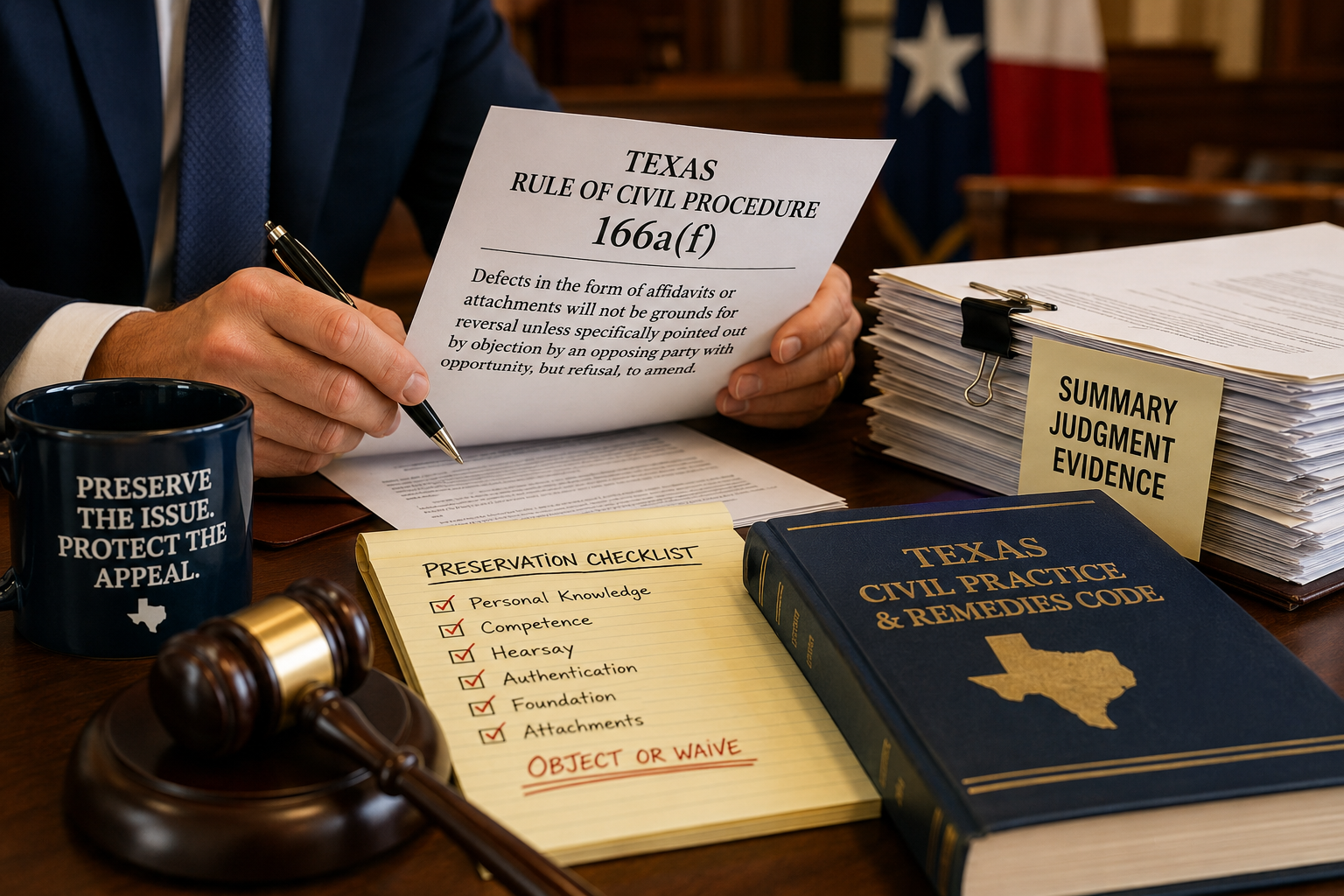
The rule also specifically addresses defects in form. It provides that defects in the form of affidavits or attachments are not grounds for reversal unless they were specifically identified by objection and the opposing party was given an opportunity, but refused, to amend.
This seemingly technical provision can have major consequences.
Texas courts apply ordinary evidentiary standards in summary judgment proceedings, but they also apply the rules governing preservation of error. As the Supreme Court of Texas explained in Seim v. Allstate Texas Lloyds, a party complaining about a formal defect ordinarily must do more than recognize the problem. The party must timely object and preserve the complaint in the trial court.
What Is a Defect of Form in Texas Summary Judgment Evidence?
A defect of form generally concerns the manner in which otherwise potentially competent evidence has been presented.
These defects are important because they are often capable of being corrected. Rule 166a(f) gives the party offering the evidence an opportunity to address such a problem after an appropriate objection.
Depending on the circumstances and the particular evidence involved, formal defects may include:
- hearsay objections;
- defects in authentication;
- failure to affirmatively demonstrate personal knowledge;
- certain defects involving attachments or referenced documents; and
- defects involving whether an affidavit has been properly sworn or verified.
The Texas Supreme Court's decision in Mansions in the Forest, L.P. v. Montgomery County demonstrates just how important the distinction can be. There, an instrument intended as an affidavit lacked a jurat or other indication that it had been sworn. Even though this implicated the basic characteristics of an affidavit, the Supreme Court treated the problem as a defect of form that had to be preserved in the trial court.
In other words, an apparently serious evidentiary defect does not necessarily mean that the opposing party can wait until appeal to complain about it.
What Is a Defect of Substance?
A substantive defect is fundamentally different.
Rather than merely concerning the way evidence was presented, a substantive defect concerns whether the evidence is legally capable of supporting the proposition for which it is offered.
One particularly important example is a conclusory affidavit.
A witness cannot ordinarily create competent summary judgment evidence merely by stating a legal or factual conclusion without providing the underlying facts supporting it. Texas courts have treated conclusory statements as substantive defects.
This distinction matters because substantive defects generally are not subject to the same preservation requirements as defects of form and may, in appropriate circumstances, be raised for the first time on appeal.
The labels therefore matter enormously. Calling something “inadmissible” or “defective” does not answer the preservation question. The court must determine what kind of defect actually exists.
Do You Have to Object to Hearsay in Texas Summary Judgment Evidence?
Generally, yes.
A hearsay objection to summary judgment evidence is ordinarily considered an objection to the form of the evidence. That means a party who believes an affidavit, declaration, or exhibit contains inadmissible hearsay should not assume the appellate court will simply disregard it later.
The objection should ordinarily be made in the trial court and properly preserved.
This creates a potentially costly trap. Evidence that might have been excluded after a timely objection can remain part of the summary judgment record when the objection is waived.
Do You Have to Object to a Conclusory Affidavit?
The analysis is different for conclusory statements.
Texas courts generally treat a complaint that an affidavit is conclusory as a substantive objection. A conclusory statement lacks the underlying factual basis necessary to support the conclusion being asserted.
For example, compare these two hypothetical statements:
“The defendant's conduct was fraudulent.”
and:
“On March 1, the defendant represented to me that the property had no prior flooding, even though an inspection report in his possession dated February 15 stated that the property had flooded twice.”
The first statement merely announces a conclusion. The second provides underlying facts from which a court can evaluate the assertion.
Whether particular testimony is actually conclusory is a fact-specific legal question, but the distinction illustrates why summary judgment affidavits should contain facts rather than unsupported conclusions.
Is Lack of Personal Knowledge a Defect of Form or Substance?
This issue requires particular care.
A complaint that an affidavit fails to affirmatively demonstrate that the witness has personal knowledge may constitute a defect of form requiring an objection.
That is different from evidence that affirmatively demonstrates that the witness could not have personal knowledge of the matter.
Consider an affidavit stating:
“I know the defendant committed fraud because everyone in the industry says so.”
Several evidentiary problems may exist.
An objection to the statement as hearsay ordinarily concerns form. A complaint that an affidavit fails to demonstrate the basis for personal knowledge may also implicate form.
But an affidavit may present a more fundamental problem when its own contents affirmatively establish that the witness lacks competent knowledge of the facts being offered.
This is one reason attorneys should identify the precise evidentiary defect rather than relying on a generalized objection that the evidence is “improper.”
Objecting Is Not Always Enough: You May Need a Ruling
One of the most important lessons from the Supreme Court of Texas's decision in Seim v. Allstate Texas Lloyds is that merely filing objections may not preserve complaints concerning defects of form.
In Seim, the Supreme Court emphasized the importance of obtaining a ruling on objections to formal defects in summary judgment evidence.
That means the preservation analysis may involve two separate questions:
- Did the party timely and specifically object?
- Did the party obtain the ruling necessary to preserve the complaint?
A lawyer who files detailed objections but never obtains the required ruling may discover on appeal that the challenged evidence remains part of the summary judgment record.
Does Granting Summary Judgment Automatically Rule on Evidentiary Objections?
Do not assume that it does.
The fact that a trial court grants a motion for summary judgment does not necessarily establish that the court sustained every evidentiary objection made by the prevailing party.
Texas appellate practice places considerable importance on whether the record actually demonstrates a ruling sufficient to preserve the particular complaint.
Accordingly, parties should address evidentiary objections directly rather than relying on the final summary judgment order to resolve them by implication.
What Evidence Should Be Reviewed Before a Texas Summary Judgment Hearing?
A party responding to or seeking summary judgment should carefully examine every piece of evidence offered in support of the motion or response, including:
- affidavits;
- unsworn declarations;
- business records;
- business-records affidavits;
- deposition excerpts;
- expert affidavits and reports;
- contracts;
- photographs;
- emails and text messages; and
- other documentary exhibits.
The analysis should not stop at whether the evidence appears persuasive.
Counsel should separately consider admissibility, authentication, personal knowledge, hearsay, conclusory testimony, competency, attachments, and whether each item actually proves the proposition for which it is offered.
A Practical Example of the Rule 166a(f) Trap
Suppose a defendant moves for summary judgment and relies heavily on an affidavit containing hearsay.
The plaintiff recognizes the hearsay problem but simply argues in the response that the affidavit is “unreliable.” The plaintiff does not specifically object to the hearsay and does not seek an evidentiary ruling.
The trial court grants summary judgment.
On appeal, the plaintiff argues that the affidavit should never have been considered because it contained inadmissible hearsay.
The plaintiff may have a serious preservation problem. Because hearsay is ordinarily treated as a defect of form in this context, the failure to make and preserve the appropriate objection may leave the evidence in the summary judgment record.
The result can be particularly frustrating because the underlying evidentiary argument might have succeeded if it had been timely presented.
Why Rule 166a(f) Matters on Appeal
Summary judgment appeals are decided on the record created in the trial court.
An appellate court ordinarily is not an opportunity to reconstruct objections that could have been made below. Preservation rules determine what complaints remain available for appellate review.
The Supreme Court of Texas has repeatedly emphasized this distinction. In Seim, the Court explained that when a complaint concerns a formal defect, an objection and appropriate ruling are critical to preservation. More recently, the Court reiterated in FieldTurf USA, Inc. v. Pleasant Grove Independent School District that evidentiary standards and error-preservation rules both apply in summary judgment proceedings.
The practical consequence is straightforward: a party can possess a potentially meritorious evidentiary argument and nevertheless lose the ability to rely upon it.
What Should a Party Do When Summary Judgment Evidence Is Defective?
A party facing questionable summary judgment evidence should identify the problem as early and precisely as possible.
Rather than simply arguing that evidence is “inadmissible,” the party should determine the particular basis for the objection and whether it concerns form, substance, or potentially both.
When preservation requires an objection, the objection should be timely and specific. When a ruling is required, the record should demonstrate the court's disposition of the objection.
For the party offering the evidence, an objection can also provide an important warning. Because many formal defects are curable, identifying the problem before the court rules may provide an opportunity to correct the evidence.
Rule 166a(f), in that sense, protects both sides: it requires objections to curable problems while giving the offering party an opportunity to address them.
Frequently Asked Questions About Texas Summary Judgment Evidence
Can you object to evidence in a Texas summary judgment proceeding?
Yes. The same basic evidentiary principles that govern admissibility at trial also apply to summary judgment evidence, although summary judgment procedure creates additional preservation issues.
What happens if you do not object to summary judgment evidence?
It depends on the defect. Complaints concerning defects of form generally must be properly preserved in the trial court. Substantive defects are treated differently and may be raised for the first time on appeal.
Is hearsay a defect of form in Texas summary judgment practice?
Generally, yes. A hearsay complaint is ordinarily considered a formal defect that must be preserved through an appropriate objection and ruling.
Is a conclusory affidavit competent summary judgment evidence?
A conclusory statement can constitute a substantive defect because it supplies a conclusion without the underlying facts necessary to support it.
Does filing an objection automatically preserve the issue for appeal?
Not necessarily. For objections to defects of form, Texas law generally requires the party not only to object but also to secure the necessary trial-court ruling.
Can a summary judgment be reversed because of defective evidence?
Potentially, but preservation matters. Rule 166a(f) expressly limits reversal based on defects in the form of affidavits or attachments when those defects were not properly raised in the trial court.
The Bottom Line
Texas Rule of Civil Procedure 166a(f) illustrates an important feature of Texas civil litigation: having a valid objection is not always enough. The objection must also be properly preserved.
For defects of form in summary judgment evidence, a party generally must timely and specifically object and obtain the necessary ruling from the trial court. Substantive defects are treated differently and may remain reviewable even without the same objection.
The distinction can affect whether an affidavit or exhibit is considered, whether summary judgment is granted, and whether an appellate court can address the issue later.
For parties involved in Texas civil litigation, summary judgment evidence should therefore be reviewed not only for what it says, but also for whether it is competent, admissible, properly supported, and procedurally preserved.
Disclaimer: This article provides general information about Texas civil procedure and is not legal advice. Summary judgment and error-preservation issues are highly dependent on the particular evidence, objections, rulings, and procedural history of a case. Anyone facing a summary judgment motion or appeal should consult a qualified Texas attorney about the specific circumstances involved.
At David C. Barsalou, Attorney at Law, PLLC, we help clients navigate business, family, tax, estate planning, and real estate matters ranging from document drafting to litigation with clarity and confidence. If you’d like guidance on your situation, schedule a consultation today. Call us at (713) 397-4678, email barsalou.law@gmail.com, or reach us through our Contact Page. We’re here to help you take the next step.