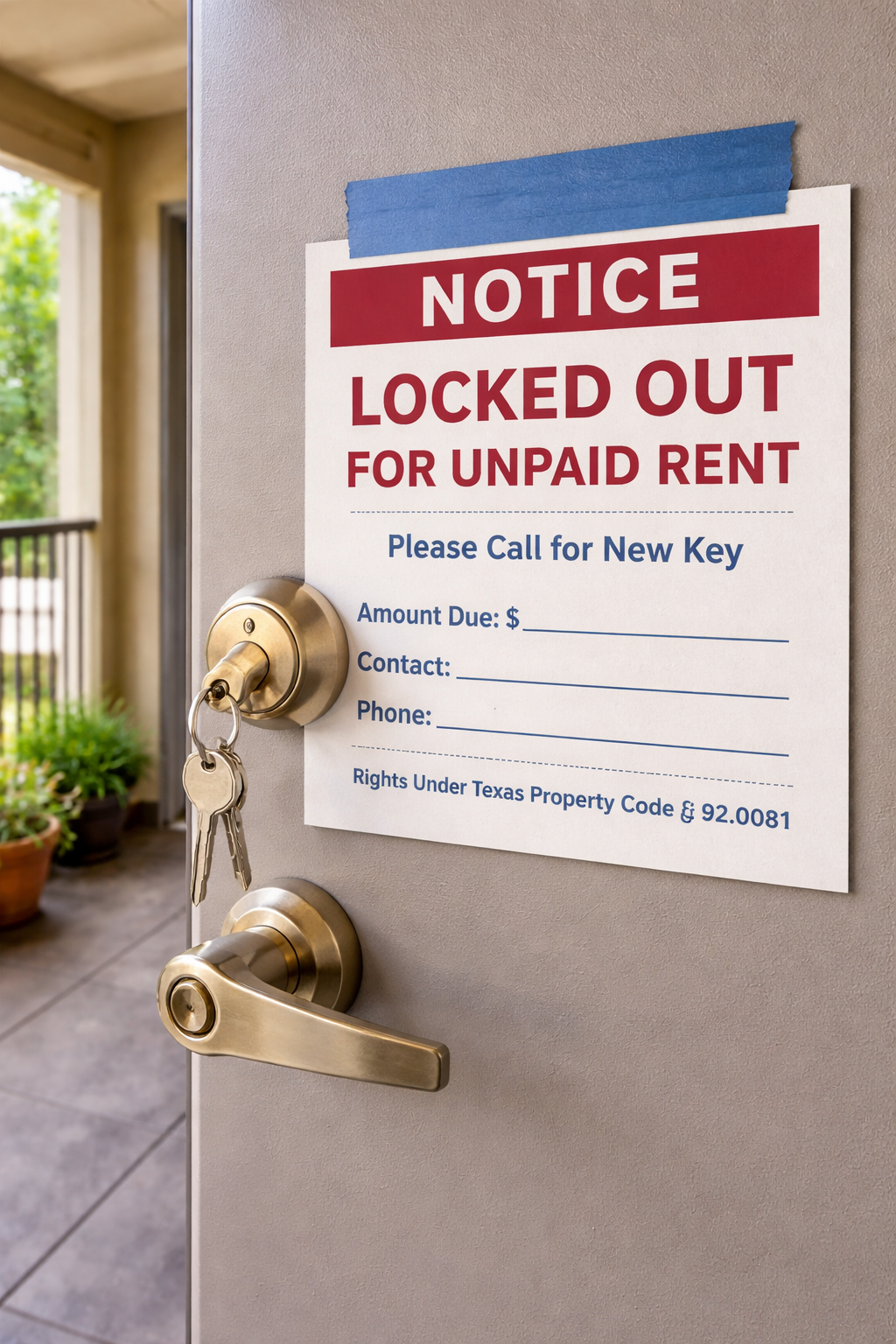
Coming home to discover that your key no longer works can be alarming. If your landlord changed the locks, you may wonder whether you have been legally evicted—or whether the landlord has violated Texas law.
A Texas landlord can change a residential tenant's locks for nonpayment of rent in certain limited circumstances. But a landlord generally cannot use a lockout to permanently evict a tenant, and Texas law requires the landlord to provide the tenant with a new key upon request even if the tenant has not paid the delinquent rent.
The rules governing residential lockouts are primarily found in Texas Property Code § 92.0081. When a landlord fails to follow those rules, a tenant may have important remedies, including seeking a writ of reentry from a justice court.
Understanding the distinction between a lawful temporary lockout and an unlawful self-help eviction is important for both Texas landlords and tenants.
Can a Landlord Legally Change the Locks in Texas?
Texas Property Code § 92.0081 generally prohibits a landlord from intentionally preventing a residential tenant from entering the leased premises except through judicial process.
The statute, however, recognizes several exceptions. Among them, a landlord may change the door locks on the individual unit of a tenant who is delinquent in paying at least part of the rent.
That does not mean a landlord has an unrestricted right to lock out a tenant whenever rent is late.
For a rent-related lockout, Texas law imposes specific requirements concerning the lease, advance notice, the notice placed on the tenant's door, and the tenant's ability to obtain a new key.
The Lease Must Permit a Lockout for Nonpayment of Rent
Under Texas Property Code § 92.0081, a landlord generally may not intentionally prevent a tenant from entering the premises through a rent-related lock change unless the landlord's right to change the locks for failure to timely pay rent is included in the lease.
The tenant must also actually be delinquent in paying all or part of the rent.
Accordingly, a landlord considering a lockout should begin with the lease itself rather than assuming that Texas law automatically authorizes changing the locks.
Texas Landlords Must Give Advance Notice Before a Rent Lockout
Texas law also requires advance written notice before the locks are changed.
The precise statutory requirements matter.
Under § 92.0081, the landlord generally must provide written notice stating, among other things:
- The earliest date on which the landlord proposes to change the locks;
- The amount of rent the tenant must pay to prevent the lock change;
- Contact information and other information required by the statute; and
- The tenant's right to receive a new key regardless of whether the tenant pays the delinquent rent.
The statute establishes different timing requirements depending on how the notice is delivered. A landlord should therefore be careful not only about what the notice says, but also when and howit is delivered.
Does the Tenant Have to Pay the Rent to Get the New Key?
No.
This is one of the most important—and frequently misunderstood—parts of Texas lockout law.
If a landlord changes the locks because of delinquent rent, the landlord must place a written notice on the tenant's front door explaining how the tenant can obtain the new key. The notice must state that the landlord is required to provide the new key regardless of whether the tenant pays the delinquent rent.
Depending on the procedure used, the notice must identify either an on-site location where the tenant can obtain the key 24 hours a day or a telephone number answered 24 hours a day through which a key can be delivered within the time specified by statute.
A Texas residential lockout is therefore not supposed to operate as a permanent exclusion from the property.
A Lockout Is Not the Same Thing as an Eviction
This distinction is critical.
A landlord's temporary exercise of lockout rights under § 92.0081 does not itself terminate the tenancy or give the landlord the legal right to permanently exclude the tenant.
An eviction is a judicial process governed primarily by Chapter 24 of the Texas Property Code and the applicable Texas Rules of Civil Procedure.
A landlord seeking possession ordinarily must proceed through the eviction process and ultimately obtain the legal authority necessary to recover possession.
Changing a tenant's locks is not a substitute for obtaining possession through the courts.
In practical terms, a landlord generally cannot simply decide:
"You did not pay your rent, so you no longer live here."
Texas law provides procedures for recovering possession, and landlords who bypass those procedures can expose themselves to liability.
When Can a Texas Landlord Not Use a Rent Lockout?
Section 92.0081 places several limitations on lockouts.
For example, a landlord may not use the rent-lockout provision when the tenant or another legal occupant is inside the dwelling.
The statute also limits how frequently a landlord may change the locks under the rent-lockout provision during a rental payment period.
Additionally, the statutory rent-lockout procedure is tied specifically to delinquent rent. It should not be treated as a general enforcement mechanism for every alleged lease violation.
A landlord dealing with unauthorized occupants, property damage, prohibited pets, lease violations, or other disputes should determine the appropriate legal remedy rather than assuming that changing the locks is permissible.
Can a Landlord Remove a Tenant's Door, Windows, or Property?
Texas law separately restricts other forms of interference with a tenant's possession.
A landlord generally cannot attempt to force a tenant out by removing doors, windows, locks, or other property in violation of the Property Code.
Likewise, landlords should be extremely cautious about attempting to remove a tenant's belongings or otherwise accomplish an eviction without judicial process.
The existence of a dispute—or even substantial unpaid rent—does not automatically authorize a landlord to bypass Texas eviction procedures.
What Should a Tenant Do After Being Locked Out?
A tenant who discovers that the locks have been changed should first determine why the lock change occurred and whether the landlord followed the statutory requirements.
Useful steps may include:
- Photographing the door and any posted notice.
- Keeping a copy of the lease and rent-payment records.
- Requesting the new key immediately.
- Documenting the date and time of the request.
- Saving text messages, emails, voicemails, and other communications with the landlord or property manager.
- Determining whether the required advance notice was provided.
- Considering whether a writ of reentry or other legal remedy is appropriate.
Documentation can become especially important if the parties later disagree about whether notice was provided, whether the tenant requested a key, or whether the landlord refused to restore access.
What Is a Writ of Reentry in Texas?
Texas Property Code § 92.009 establishes a procedure for a residential tenant seeking to regain possession after an alleged unlawful lockout.
A tenant may file a sworn complaint for reentry in the justice court for the precinct where the rental property is located.
The complaint must state the facts concerning the alleged unlawful lockout. The tenant must also provide the required sworn information to the justice.
If the statutory requirements are satisfied and the justice reasonably believes that the tenant has been unlawfully locked out, the court may issue a writ of reentry ordering the tenant restored to possession.
This remedy is designed to address possession promptly. It is separate from the ultimate merits of an eviction case or other claims between the landlord and tenant.
What Happens If a Landlord Ignores a Writ of Reentry?
A writ of reentry is a court order.
Texas Property Code § 92.009 provides procedures that may lead to contempt proceedings if a landlord or the landlord's agent disobeys the writ.
That makes an unlawful lockout materially different from an ordinary disagreement over rent. Once a court issues a writ directing restoration of possession, ignoring it can create additional legal consequences.
Can a Tenant Recover Damages for an Illegal Lockout in Texas?
Potentially.
Texas Property Code § 92.0081 provides statutory remedies when a landlord violates the lockout provisions.
Depending on the circumstances, a tenant may be entitled to recover remedies that can include:
- Possession or termination of the lease;
- Actual damages;
- Statutory monetary damages;
- Court costs; and
- Reasonable attorney's fees.
The particular remedies available depend on the nature of the violation and the applicable statutory provisions.
Landlords should therefore avoid viewing the lockout rules as mere technicalities. An improperly conducted lockout can create a claim that did not exist before the landlord attempted to collect the unpaid rent.
Can a Tenant Waive Texas Lockout Protections in a Lease?
Texas Property Code § 92.0081 specifically restricts attempts to contract around its protections.
A lease provision purporting to waive a right or exempt a party from a liability or duty imposed by § 92.0081 is void.
That means a landlord generally cannot solve a statutory lockout problem simply by inserting broader lockout language into the lease.
The lease matters, but it remains subject to Texas law.
Can a Landlord Still File an Eviction After a Lockout?
Yes.
The lockout statute does not prevent a landlord from pursuing other available remedies, including remedies under Chapter 24 of the Texas Property Code.
A landlord may therefore have the right to pursue an eviction for unpaid rent even though the tenant is entitled to receive a replacement key following a statutory lockout.
This illustrates why lockout and eviction are two different legal concepts.
A landlord may temporarily change locks under the narrow circumstances authorized by § 92.0081 while separately pursuing an eviction through the courts.
Frequently Asked Questions About Texas Landlord Lockouts
Can my landlord lock me out for not paying rent in Texas?
Potentially, but only if the requirements of Texas Property Code § 92.0081 are satisfied. Among other requirements, the tenant must be delinquent in rent, the lease must provide the applicable lockout right, and the landlord must comply with statutory notice and key-access requirements.
Can my landlord refuse to give me a key until I pay?
Generally, no. Following a rent-related lock change under § 92.0081, the landlord must provide the tenant with a new key upon request regardless of whether the delinquent rent has been paid.
Does changing the locks mean I have been evicted?
No. A lock change under § 92.0081 is not the same as a judicial eviction. A landlord generally must use the legal eviction process to permanently recover possession from a tenant.
Can my landlord lock me out without warning?
A rent-related lockout generally requires advance written notice meeting the requirements of § 92.0081. The statute contains specific rules governing the timing and contents of that notice.
What court handles an illegal lockout in Texas?
A tenant seeking a writ of reentry under Texas Property Code § 92.009 files the sworn complaint in the justice court for the precinct where the rental premises are located.
Can a landlord lock out a tenant who is inside the apartment?
Section 92.0081 prohibits a landlord from changing the locks under its rent-lockout provision while the tenant or another legal occupant is in the dwelling.
Texas Landlords and Tenants Should Treat Lockouts Carefully
Texas permits residential landlords to change locks for delinquent rent in limited circumstances, but the procedure is much narrower than simply locking out a tenant who owes money.
The most important points are straightforward:
- A lockout is not an eviction.
- The lease and statutory requirements matter.
- Advance notice is generally required for a rent-related lockout.
- The tenant must be able to obtain a new key even without paying the delinquent rent.
- A tenant who is unlawfully excluded may seek a writ of reentry.
- Violations can expose a landlord to damages, costs, and attorney's fees.
For landlords, strict compliance can prevent an attempt to collect rent from becoming a separate legal dispute. For tenants, knowing the difference between a lawful temporary lock change and an unlawful exclusion can help protect the right to possession.
Because landlord-tenant disputes can turn on the lease, notices, payment history, and the precise sequence of events, anyone dealing with a disputed Texas lockout should evaluate the particular facts and the current requirements of the Texas Property Code.
At David C. Barsalou, Attorney at Law, PLLC, we help clients navigate business, family, tax, estate planning, and real estate matters ranging from document drafting to litigation with clarity and confidence. If you’d like guidance on your situation, schedule a consultation today. Call us at (713) 397-4678, email barsalou.law@gmail.com, or reach us through our Contact Page. We’re here to help you take the next step.