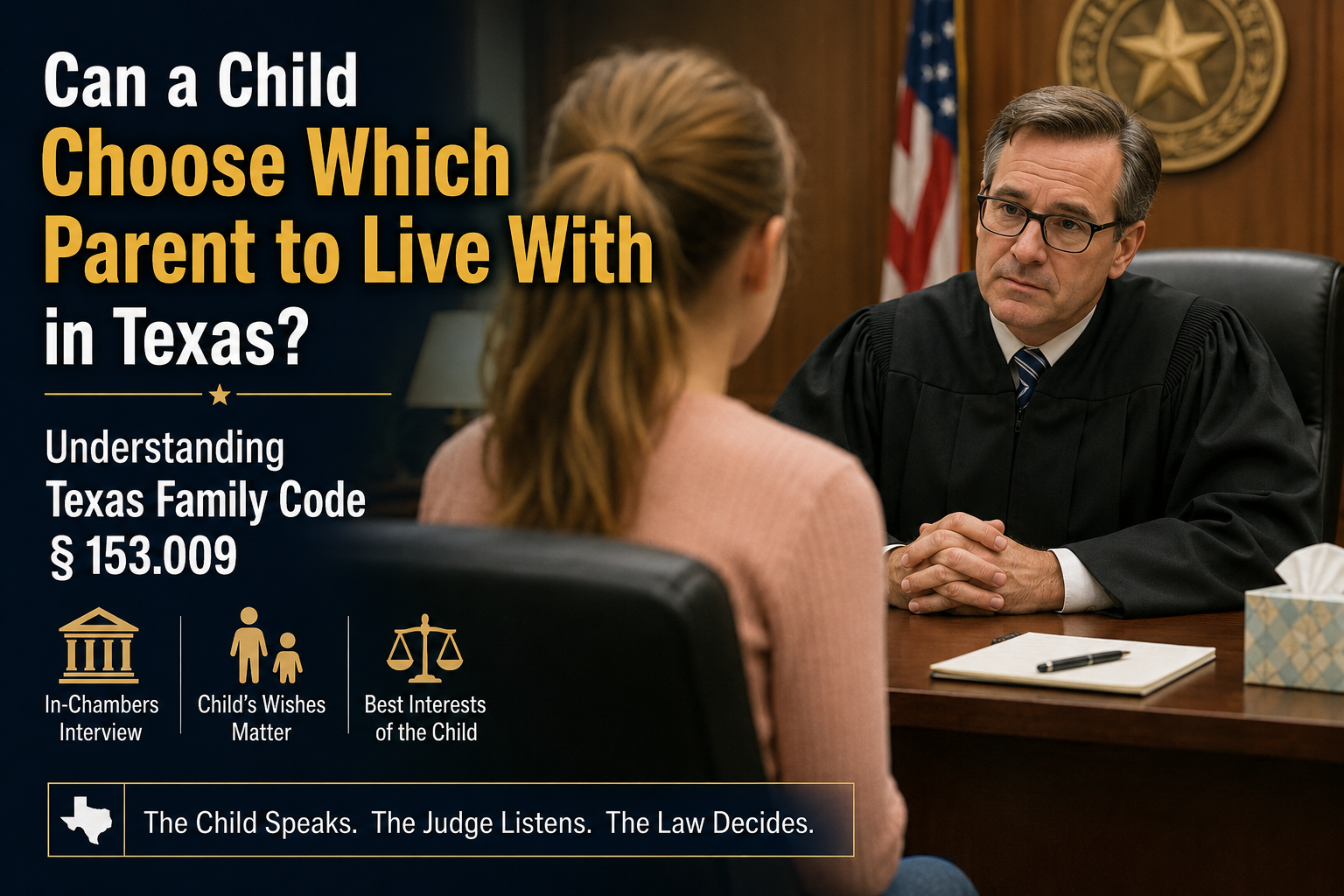
Can a Child Choose Which Parent to Live With in Texas?
One of the most common misconceptions in Texas family law is that a child automatically gets to decide which parent he or she will live with upon turning twelve years old. Although Texas law gives older children an opportunity to speak privately with the judge in certain custody cases, the child does not make the final decision. Instead, the judge considers the child's wishes as one factor among many when determining what arrangement serves the child's best interests.
Understanding this distinction can help parents avoid unnecessary conflict and unrealistic expectations during custody litigation.
What Does Texas Family Code § 153.009 Say?
Texas Family Code § 153.009 provides, in relevant part:
"(a) In a nonjury trial or at a hearing, on the application of a party or on the court's own motion, the court shall interview in chambers a child 12 years of age or older and may interview in chambers a child under 12 years of age to determine the child's wishes as to conservatorship or as to the person who shall have the exclusive right to determine the child's primary residence."
The statute further authorizes the court to interview the child regarding possession, access, and other issues affecting the child's welfare.
Notice what the statute does not say. It does not provide that a twelve-year-old chooses where to live. Instead, it requires the court, upon proper request, to conduct an in-camera interview with a child who is at least twelve years old.
What Is an In-Chambers Interview?
An in-chambers interview occurs in the judge's office or chambers rather than in open court. The purpose is to allow the child to speak more freely without the pressure of testifying in front of parents, attorneys, or a crowded courtroom.
Depending upon the circumstances, a court reporter may be present to create a record, and the interview itself generally remains confidential except as otherwise provided by law or court order.
Does Turning Twelve Give a Child the Right to Decide?
No.
Texas courts decide conservatorship and possession according to the best interests of the child, not simply the child's stated preference.
A judge may determine that a child's wishes should receive substantial weight. In another case, the judge may conclude that the child's preference resulted from:
- Pressure from a parent;
- Temporary disagreements over household rules;
- Gifts or promises made by a parent;
- Emotional manipulation; or
- Other circumstances suggesting the preference is not independently formed.
The child's opinion matters, but it is rarely the only consideration.
What Factors Will the Judge Consider?
Texas courts evaluate numerous factors, including:
- Each parent's ability to care for the child;
- Stability of each household;
- Emotional and physical needs of the child;
- School performance;
- Safety concerns;
- History of family violence or neglect;
- The child's emotional maturity; and
- The child's stated preferences.
Every custody case is unique, and no single factor controls the outcome.
Can a Child Under Twelve Speak to the Judge?
Yes.
Although an interview is mandatory upon proper request for many children age twelve or older, the statute also permits the judge to interview younger children if the court believes doing so would be helpful.
Whether such an interview occurs depends upon the particular facts of the case.
Strategic Considerations
Parents sometimes assume requesting an interview guarantees a favorable outcome. In reality, experienced family law attorneys carefully evaluate whether requesting the interview helps or hurts the case.
For example:
- A mature, articulate child may provide helpful information.
- A child experiencing loyalty conflicts may become unnecessarily stressed.
- The interview may reveal facts neither parent anticipated.
Because of these risks, the decision should be made strategically rather than emotionally.
Common Misconceptions
Myth: A twelve-year-old chooses where to live.
Reality: The child expresses a preference, but the judge makes the final decision.
Myth: The judge must follow the child's wishes.
Reality: The child's wishes are only one piece of the best-interest analysis.
Myth: Younger children are never interviewed.
Reality: Judges have discretion to interview younger children when appropriate.
Final Thoughts
Parents understandably want their children's voices to be heard. Texas law recognizes that older children often possess meaningful insight into their own lives. However, Texas courts remain responsible for making custody decisions based upon the child's best interests—not simply the child's preference.
If you are involved in a custody modification or conservatorship dispute, understanding how Texas Family Code § 153.009 actually operates can help you make informed decisions and avoid costly misconceptions.
Disclaimer: This article is intended for general educational purposes only and does not constitute legal advice. Every custody case is unique. If you have questions about conservatorship or possession in Texas, consult an attorney regarding your specific circumstances.
At David C. Barsalou, Attorney at Law, PLLC, we help clients navigate business, family, tax, estate planning, and real estate matters ranging from document drafting to litigation with clarity and confidence. If you’d like guidance on your situation, schedule a consultation today. Call us at (713) 397-4678, email barsalou.law@gmail.com, or reach us through our Contact Page. We’re here to help you take the next step.